
Emotion-Cause Extraction from Patient Narratives
Tobyoki Emo-Cause: Patient Emotion-Cause from Tobyoki
Medical NLP · Patient narratives · Dataset construction
Overview
Significance and Objectives of Emotion-Cause Extraction
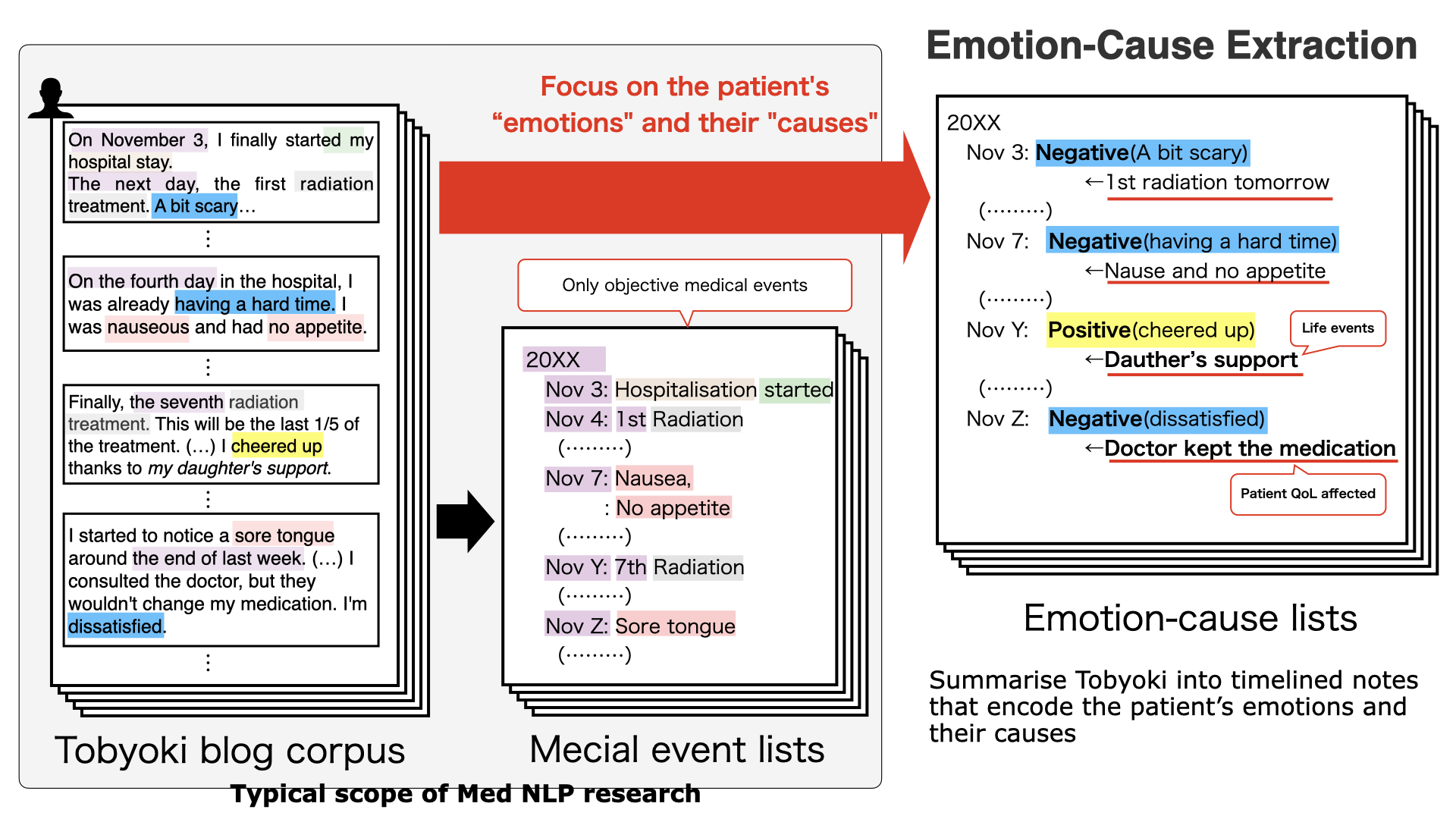
Patient narratives written by patients and people close to them record subjective emotions and changes in quality of life (QoL) that clinical data alone cannot readily capture. Anxiety, distress, relief, and encouragement from family are important for understanding the treatment journey.
This research uses natural language processing to link and structure emotions expressed in patient narratives with the events that triggered them, or their emotion causes. It covers not only medical events but also life events and sources of psychological support. The resulting structured data will support medical analyses and applications for clinicians and patients.
Method
Main Approach
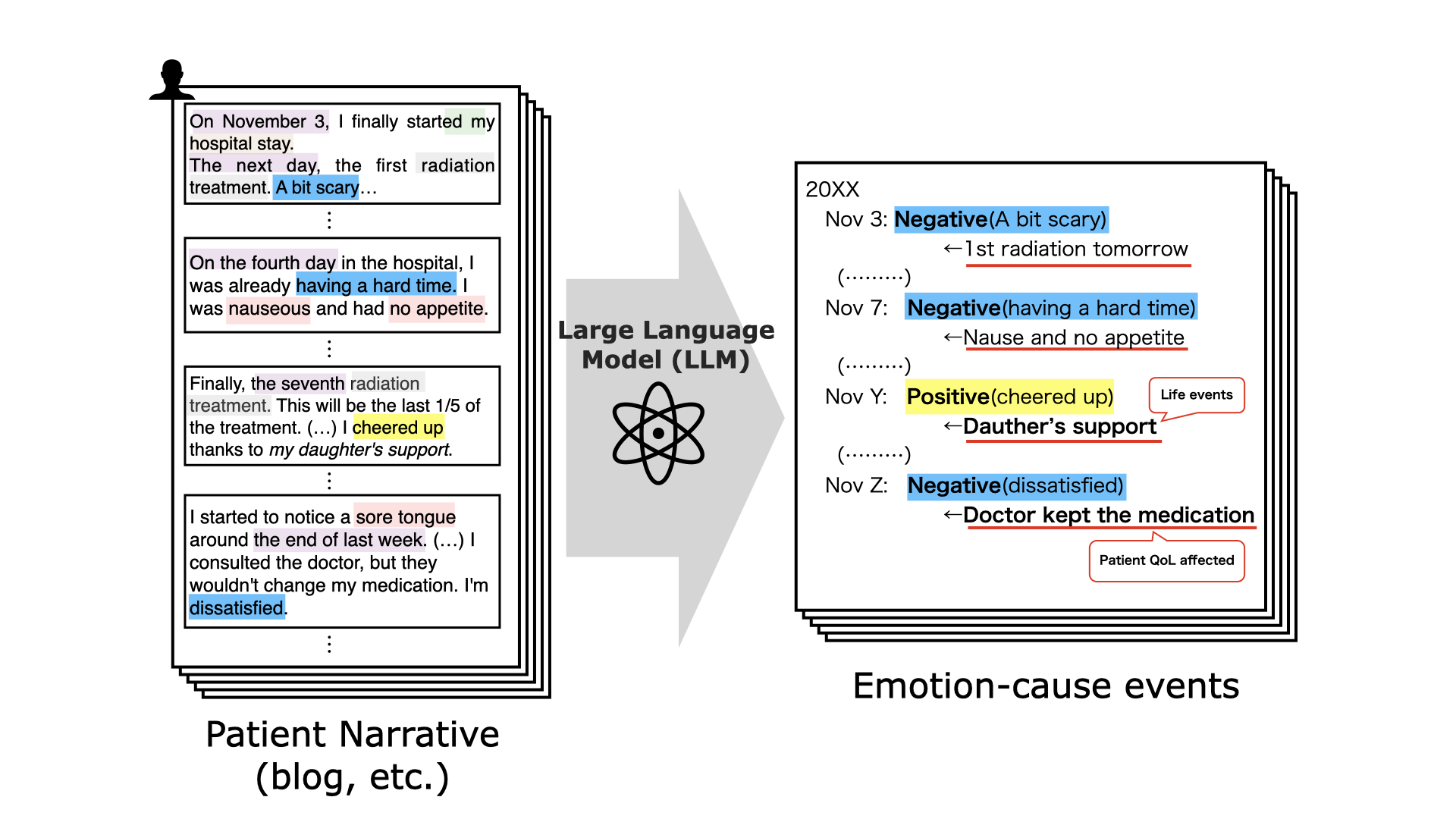
This research creates emotion-event summaries from publicly available patient narratives in formats such as blogs, social media posts, and books. These summaries organise emotional expressions and their corresponding causes chronologically.
Large language models (LLMs) are used to extract emotion causes, followed by human correction. During extraction, proper nouns and other potentially identifying information are abstracted to protect privacy while preserving the event structures required for subsequent medical analyses.
Future Directions
What the Project Enables
Add information about what patients felt and what caused those feelings to timelines of symptoms, treatment, medication, examinations, and hospital visits.
Abstract identifying details such as people, places, and institutions while retaining the event structure needed for analysis.
Extend the task to patient narratives in multiple languages and develop emotion-cause data for cross-linguistic comparative analysis.
External References
- Disease Experience Search — a NAIST Social Computing Laboratory search interface for disease-experience narratives.
- PRISM Annotator — a CLI tool for automatic PRISM annotation of medical and clinical texts using LLMs.
- TobyokiSummary — a medical-event summarisation dataset drawn from Japanese patient-narrative blogs.