Integration of Knowledge Across All Academic Fields
through Automatic Construction of Specialised Dictionaries
TermAtlas
JST FOREST Programme, Selected 2024 — Research Period: FY 2025–2032
PI: Shuntaro Yada, Associate Professor, Institute of Library, Information and Media Science, University of Tsukuba
Project overview presentation (approx. 10 min)
Why this research?
Research Overview
In today's highly specialised academia, the creation and revision of concepts is so rapid that knowledge organisation cannot keep pace. Specialised dictionaries are invaluable resources that systematise the knowledge of a given field, yet their compilation requires enormous cost and time, with revision cycles spanning 10 to 20 years. In rapidly advancing fields, dictionaries may never be published at all.
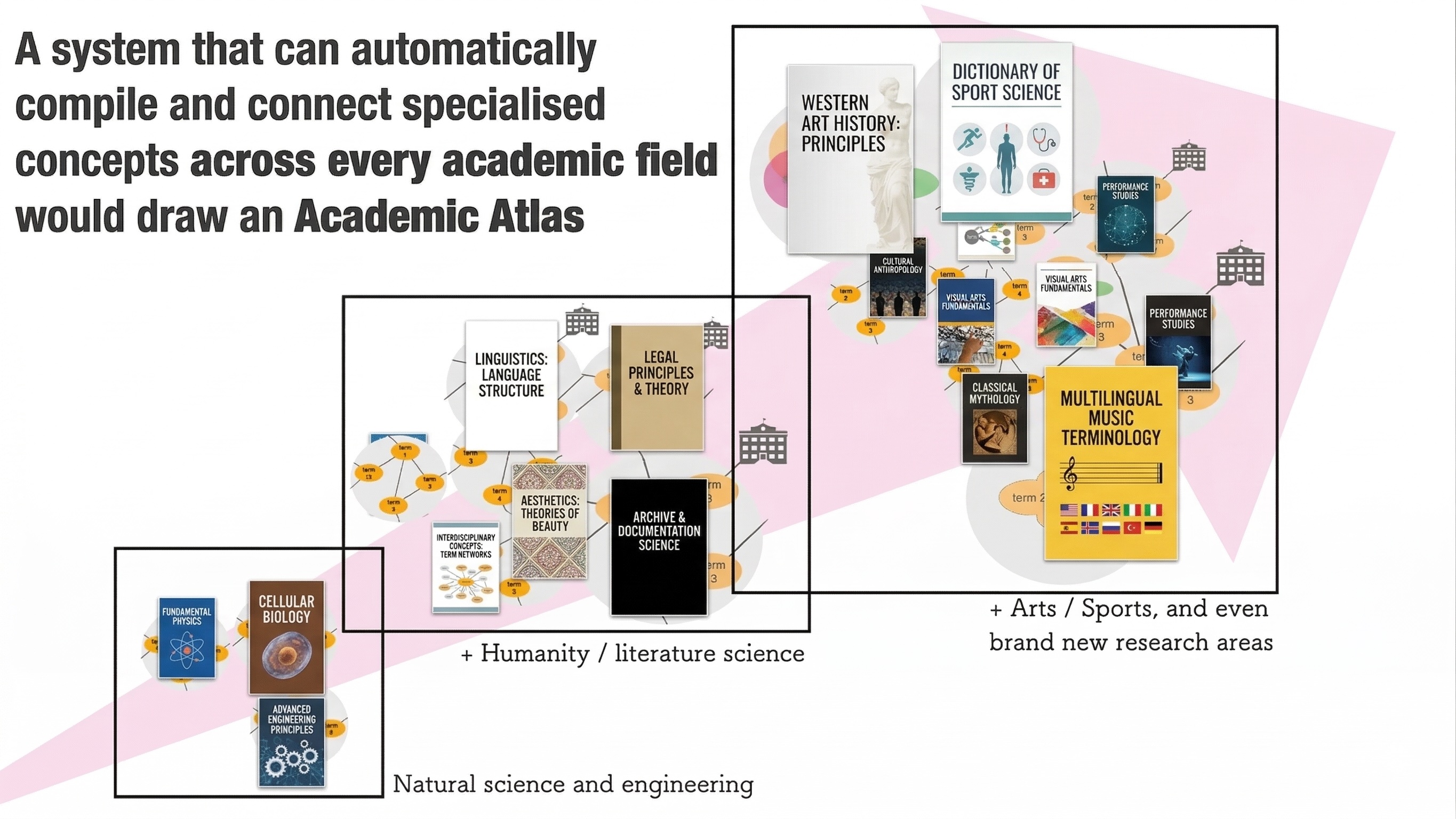
This research aims to develop a system that automatically constructs and revises specialised dictionaries. Covering science and engineering, the humanities and social sciences, and extending to all fields including physical education and the arts, the project seeks to visualise cross-disciplinary terminological relationships — drawing a "world map" of our increasingly complex academic landscape.
How it works
Approach
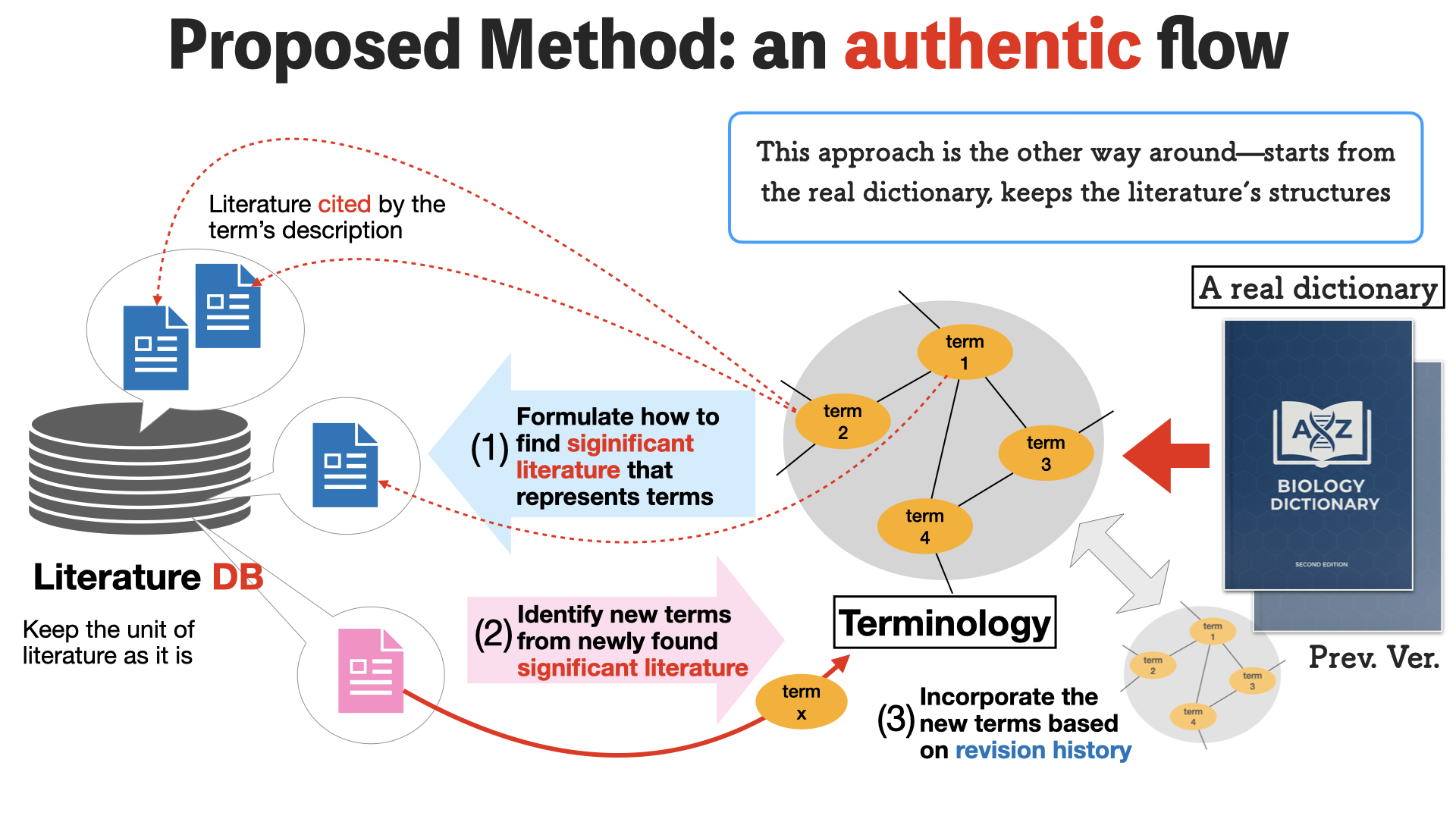
Conventional automatic term extraction research has predominantly relied on statistically identifying "prominent words" from large paper corpora. This research reverses that logic, taking real specialised dictionaries as the starting point and analysing the attributes of key papers cited in their definitions and explanations.
By formalising the relationship between "key papers" and "terms", the system automates the entire pipeline — from discovering new key papers to detecting terms, incorporating them, and generating definitions. Furthermore, by using dictionary revision histories as clues, the project seeks to objectively elucidate the hitherto tacit editorial decision-making process.
Innovations
Innovations of the Academic "World Map"
Elucidate the mechanisms behind the decision to include terms in dictionaries and encyclopaedias by analysing revision histories.
Track the emergence of new research areas through temporal changes in terminologies driven by automatic updates.
Dynamically generate definitions tailored to the reader's expertise and proficiency, grounded in reliable sources.
Systematised academic knowledge serves as a valuable external reference point for countering generative AI hallucinations.
Help Us by Sharing Your Specialised Dictionaries
This research analyses specialised dictionaries and encyclopaedias across all academic fields. If you are a publisher or academic society interested in providing dictionary data for this project, please get in touch.
Related Publications
- K. Kageura, T. Fujii, S. Yada, R. Miyata, "Terminologists as Social Custodians of Knowledge: Clarifying the Expertise of Terminologists and the Status of Terminologies", Proceedings of the 2025 Asia-Pacific Library and Information Education and Practice (A-LIEP), 2025.
Only publications directly related to this project are listed here. For the PI's full publication list, see TRIOS.